
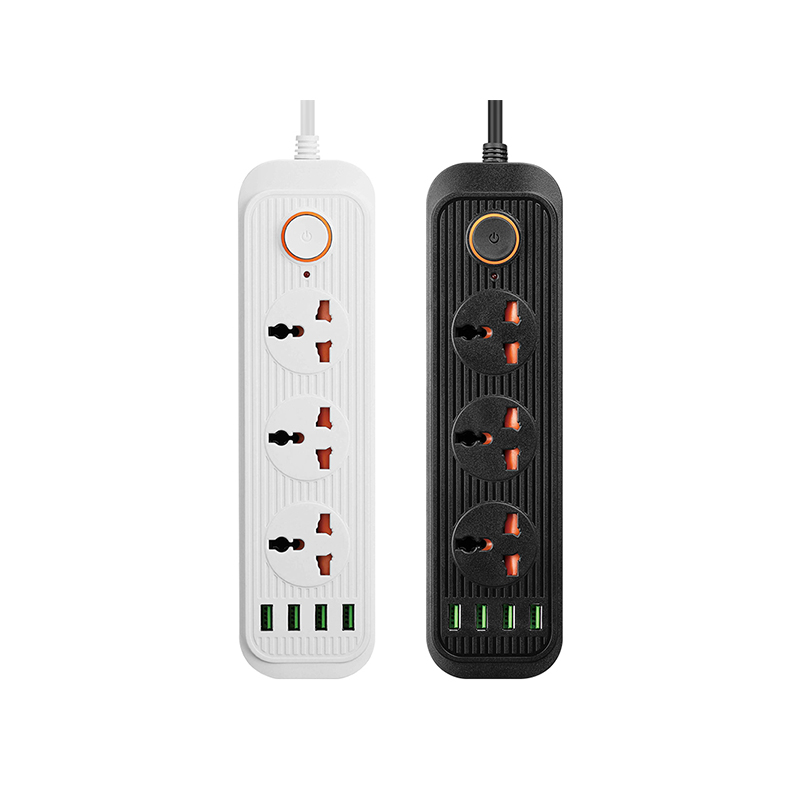
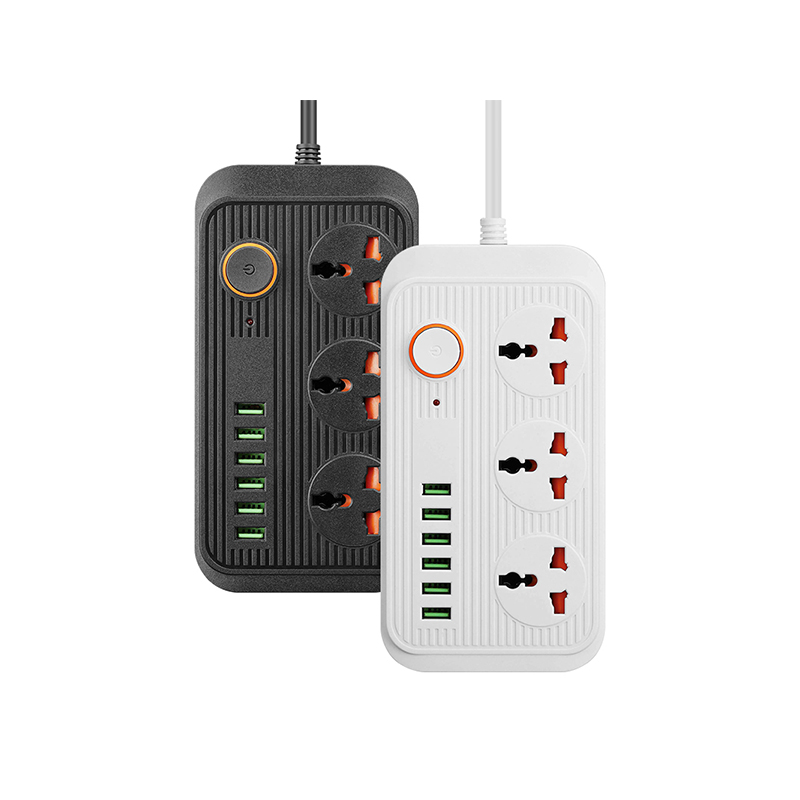
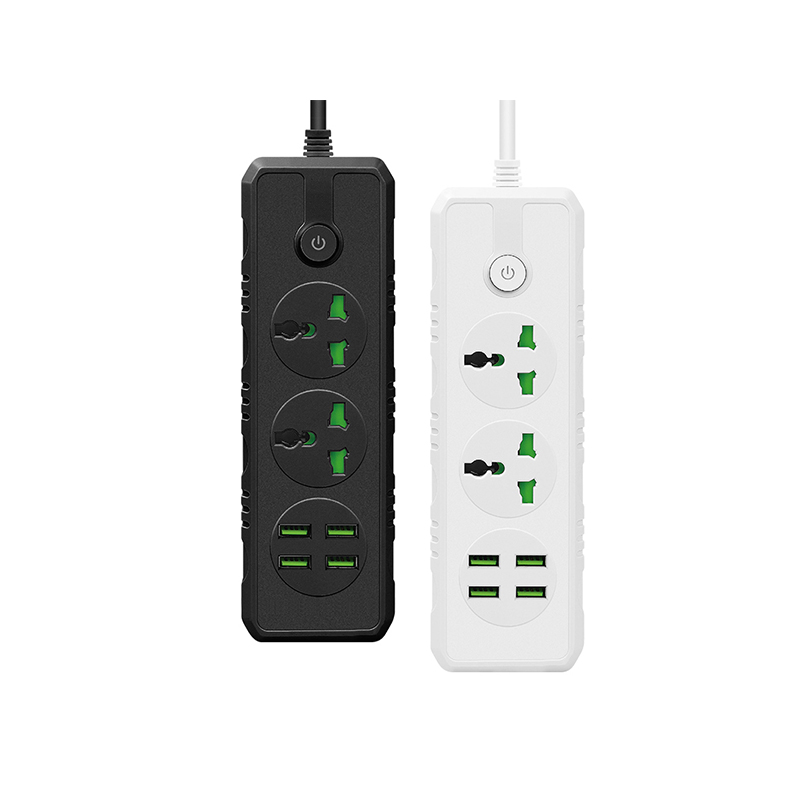
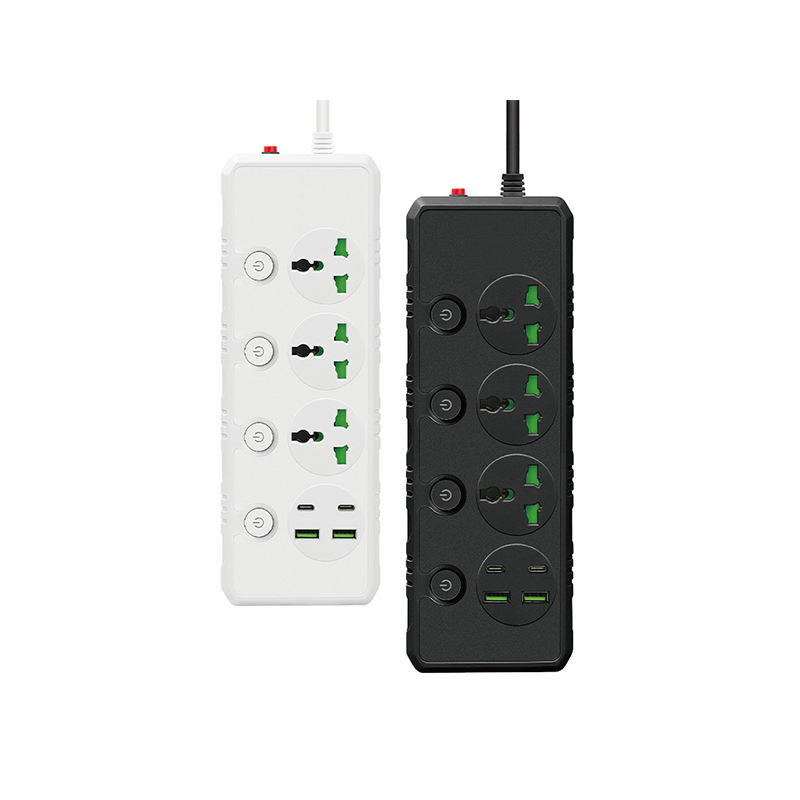


How does the surge protection function of Power Strip resist voltage surges?
Release Time : 2025-12-09
Power Strip's surge protection function is the core defense against sudden voltage surges. Its design integrates materials science, circuit topology, and energy management technology. Through a multi-level collaborative mechanism, it transforms the destructive force of transient overvoltages into controllable energy, providing an "invisible shield" for electrical equipment. This function requires comprehensive analysis from four dimensions: core components, energy absorption paths, response speed, and system compatibility.
The core component of surge protection is the metal oxide varistor (MOV). This nonlinear resistor, made of zinc oxide ceramic, exhibits high resistance under normal voltage, acting like a "circuit breaker" and consuming almost no electrical energy. However, when the voltage suddenly increases to a threshold (such as a transient overvoltage caused by lightning strikes or power grid faults), its impedance drops sharply to the milliohm level, forming a "short-circuit path" that guides the surge current to ground, preventing it from entering the electrical appliance. The MOV's response speed can reach the nanosecond level, far faster than the millisecond response of traditional fuses, completing the protective action before the voltage spike damages the component. For example, when lightning strikes a power line, the surge voltage can escalate to thousands of volts within microseconds, while an MOV (Metal Oxide Valves) can activate within tens of nanoseconds, clamping the voltage within a safe range.
The design of the energy absorption path is another key aspect of surge protection. Modern power strips often employ a "tiered protection" strategy: inside the socket, the MOV acts as the first level of protection, absorbing most of the surge energy; if the surge intensity exceeds the MOV's withstand limit, the second level of protection—a gas discharge tube (GDT) or transient voltage suppressor diode (TVS)—takes over. The GDT creates a conductive path by ionizing the internal gas, diverting high-energy surges; the TVS utilizes the breakdown characteristics of the P-N junction to guide the remaining energy to ground with an extremely low clamping voltage. This "multi-level buffer" design acts like a "bulletproof vest" for electrical equipment, progressively weakening the destructive force even in the face of extreme surges.
Optimization of response speed directly determines the protection effectiveness. Traditional surge protection technologies often damage appliances due to delayed response, while modern power strips, through optimized MOV (Metal Oxide Valves) formulations and structures, have reduced response times to nanosecond levels. For example, MOVs using nano-sized zinc oxide particles have lower grain boundary resistance and faster electron migration, enabling instantaneous state switching during voltage surges. Furthermore, some high-end sockets incorporate "smart monitoring chips" that analyze voltage waveforms in real time, predicting surge trends and further reducing response delays.
System compatibility is crucial for the effective implementation of surge protection. Power strips must adapt to the power requirements and voltage levels of different appliances to avoid disrupting normal power supply due to protection actions. To this end, designers employ "dynamic threshold adjustment" technology: the MOV's clamping voltage automatically adjusts according to the appliance's operating status. For example, when charging a mobile phone, the clamping voltage is set at the lower limit of the safe range to reduce energy loss; while when powering an air conditioner, the clamping voltage is increased to ensure stable operation of high-power devices. In addition, some sockets are equipped with "overload protection" and "temperature monitoring" functions, automatically cutting off power when a surge causes abnormal internal temperatures to prevent fire risks.
The effectiveness of surge protection has been verified through numerous experiments. Taking the Bull surge protector as an example, under a simulated 6KV surge in the laboratory, its output voltage fluctuation is controlled within a very small range, far below the limits that appliances can withstand. In contrast, ordinary sockets experience voltage spikes in the same test, easily leading to capacitor breakdown, PCB burnout, and other malfunctions. In long-term use, surge protectors can extend the lifespan of appliances and reduce performance degradation caused by voltage fluctuations.
From an application perspective, surge protection has expanded from industrial applications to home and office environments. In data centers, servers and storage devices have extremely high power quality requirements; surge protectors can prevent data loss caused by power fluctuations. In homes, smart appliances such as televisions and computers are highly sensitive to voltage fluctuations due to their built-in chips; surge protectors can effectively prevent screen flickering, noise, and short battery life. In industrial automation control systems, the stable operation of critical equipment such as PLCs and DCSs depends on surge protection; otherwise, electromagnetic interference could cause production line shutdowns.
Power Strip's surge protection feature, through innovation in core components, optimization of energy paths, improved response speed, and enhanced system compatibility, constructs a complete protection system from nanosecond-level response to long-term stable operation. This feature is not only an "invisible guardian" of electrical safety but also the "last line of defense" for modern electrical systems against voltage surges. With technological advancements, surge protection will evolve towards greater intelligence and efficiency, providing more comprehensive safety assurance for electrical equipment.